

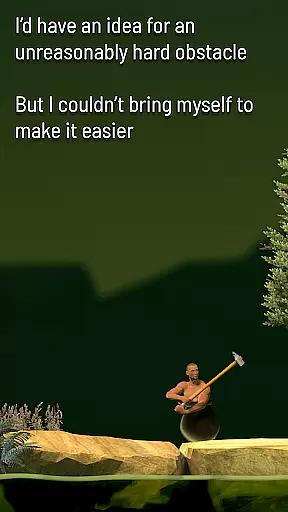
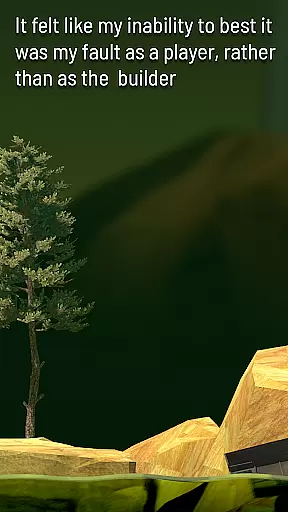
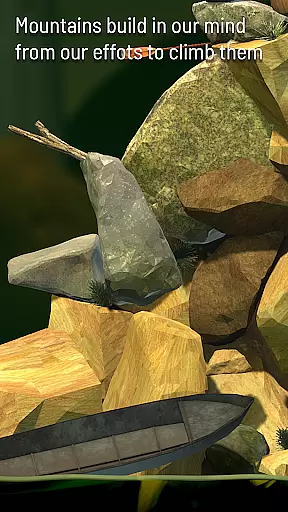
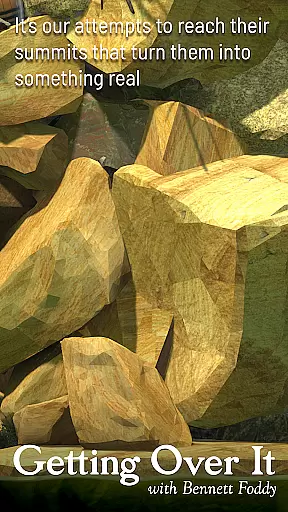

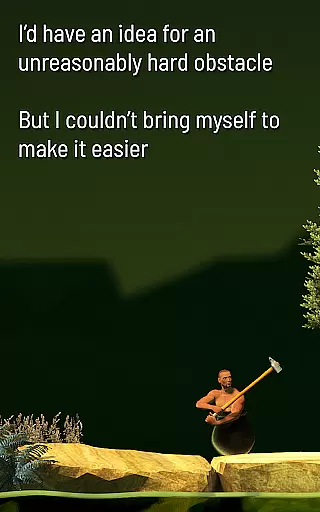
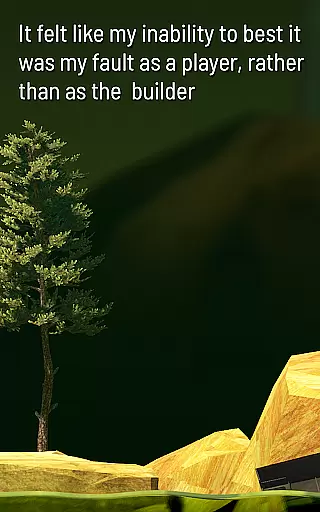



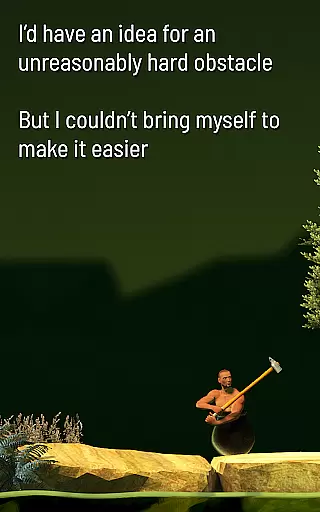

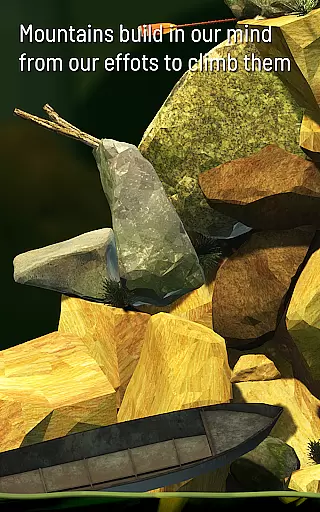

Getting Over It with Bennett Foddy is a challenging climbing simulation game that tests players' patience and skill. In this game, you control a character equipped with only a hammer and a pot, attempting to scale an enormous mountain. The gameplay is intentionally difficult, designed to evoke feelings of frustration and triumph as players progress. With philosophical narration by the creator, the game offers a unique experience that combines humor, difficulty, and deep reflections on perseverance.
The game pays homage to Jazzuo's 2002 classic 'Sexy Hiking', capturing its spirit of unforgiving challenge. Players must master precise movements using the mouse to control the hammer for jumping, swinging, climbing, and even flying. Each attempt can take hours, but one wrong move can cause you to lose all your progress, making every decision critical. This creates an intense emotional journey where success feels truly rewarding.
One of the standout features of Getting Over It is its minimalist control scheme. You are given just a hammer to navigate through complex obstacles, requiring precision and timing. The physics-based mechanics make each movement feel realistic yet unpredictable, adding layers of complexity to the gameplay. As you climb higher, the challenges become increasingly intricate, demanding both strategy and adaptability.
Beyond its core mechanics, the game includes philosophical commentary from Bennett Foddy himself. These insights provide context and depth, transforming what could be a simple climbing simulator into a thought-provoking experience about struggle and persistence. Additionally, the game boasts great mysteries and rewards for those who reach the summit, encouraging replayability despite its punishing difficulty.
Visually, the game employs a quirky art style reminiscent of early internet games, enhancing its charm and nostalgic appeal. Coupled with responsive controls and endless replay value, Getting Over It delivers a memorable gaming experience that resonates with players long after they've put down the controller.
In Getting Over It, the economic system is not about money but centers around the player's progress and perseverance. The game challenges players with a unique 'loss' mechanic where they can lose significant progress if they fall from the mountain. This creates an intricate balance between risk and reward, pushing players to weigh their decisions carefully.
The dynamic feedback system in the game is designed to respond to the player's actions in real-time. Each movement of the hammer or jump can lead to success or failure, providing immediate feedback that affects the player's strategy. This constant interaction keeps players engaged and forces them to adapt their tactics continuously.
Players benefit from this system by learning to anticipate potential pitfalls and understanding the consequences of their actions within the game. The feedback loop encourages a deeper engagement with the mechanics, leading to mastery over time. As players become more adept, they develop a nuanced understanding of the physics and timing required to navigate the challenging terrain.
This feature adds a layer of complexity and realism to the gameplay experience, making each attempt feel meaningful. The depth of the economic system lies in its ability to simulate the highs and lows of real-world endeavors, teaching patience and persistence through virtual trials.
Resource management in Getting Over It revolves around the efficient use of the hammer and the player's physical dexterity. Unlike traditional resource management games, this title focuses on the player's skill and precision rather than accumulating resources. Every swing of the hammer must be calculated to avoid losing progress.
The balance of resource management is maintained through the game's punishing yet fair difficulty curve. Players quickly learn that reckless actions lead to setbacks, while thoughtful and measured movements yield better results. This balance ensures that the game remains challenging without feeling impossible, offering a rewarding experience for those who invest time and effort.
Users gain valuable skills in patience and strategic thinking as they manage their virtual resources. The game teaches players to value incremental progress and appreciate small victories, reinforcing the importance of persistence. These lessons translate into a satisfying gameplay experience that feels earned rather than given.
Ultimately, the resource management aspect of Getting Over It provides a fresh take on the simulation genre. By focusing on player skill and decision-making, it offers a unique challenge that rewards careful planning and execution. This approach sets the game apart from others in its category, delivering a memorable and educational experience.
Unique concept
Engaging gameplay
Philosophical depth
Challenging experience
Nostalgic design
Extremely difficult
Frustrating at times
Limited controls
Repetitive gameplay
Not for everyone

Survive, explore, and invent wild machines in a world ruled by robots!
 4.4
4.4
A fun and challenging bridge builder puzzle game.
4.20
Can you infect the world?
4.70
40+ original, licensed construction vehicles, over 60 jobs, USA setting.
3.90
The most realistic digital combat flight simulator
3.40
Rediscover your engineering creativity in this bridge building masterpiece.
4.10
Family, house & life simulator - build your dream home in a virtual world!
4.50
Explore the open world and run your business empire in this real life simulator!
4.50
One to rule them all
3.90
Makeup, dress up and skincare for your princess fashion
4.70
Pro Wrestling Team Management Sim, Face off with fearsome foes!
4.50
Play and earn real BTC rewards!
4.50
Change lives in Flop House: Become the idle manager of a homeless shelter!
4.50
Fly around the world with Aerofly FS Global Flight Simulator
4.30
A casual city building game. Become the mayor and create your own metropolis!
4.30
Experience the ultimate vehicle simulator with realistic soft-body physics
4.20
Build and explore your city as mayor! Create and simulate your own metropolis.
4.20
Become a pilot! Fly and land in airports around the world with iconic airplanes
4.20
Explore Mimo Land – where you can shop, decorate your home, relax at the spa!
3.70


User Reviews